Until the 1930s, industry in Eretz Israel* suffered from poor infrastructure, competition from imported goods, and a “stepchild” attitude on the part of the settlement institutions toward agriculture. Immigration from Central Europe was one of the main factors in the development of industrial production in the country. The “Transfer” (Ha’avara) Agreement made it possible to convert the immigrants’ capital and property into means of production and bring them to Eretz Israel. In this way, these immigrants introduced efficient and modern equipment into the country. They implemented new production methods for existing products and triggered a boom of development in various industries.
Seventy percent of the capital invested in industry by Central European immigrants flowed into four main sectors: metal, food, textiles, and paper. Their investments were reflected in the establishment of factories and in the development of a wide range of products and production methods in these fields, as well as in other industries such as chemicals, optics, electronics, and more. Not all factories established in this way were successful in the long term. Some encountered financial difficulties and were also affected by local and global political changes. However, the companies that have survived to this day constitute a significant part of the Israeli economy.
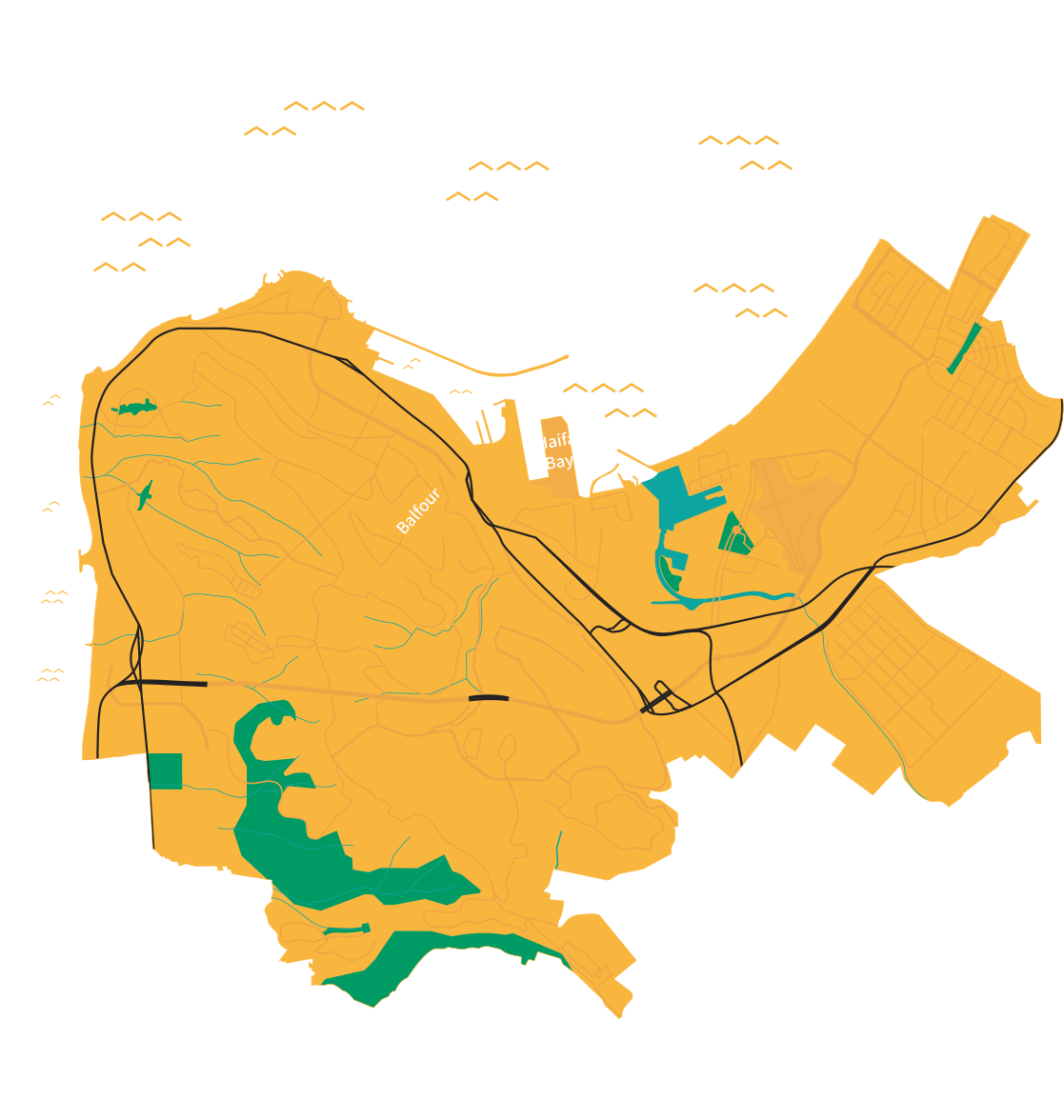
Haifa and the Krayot
Telma
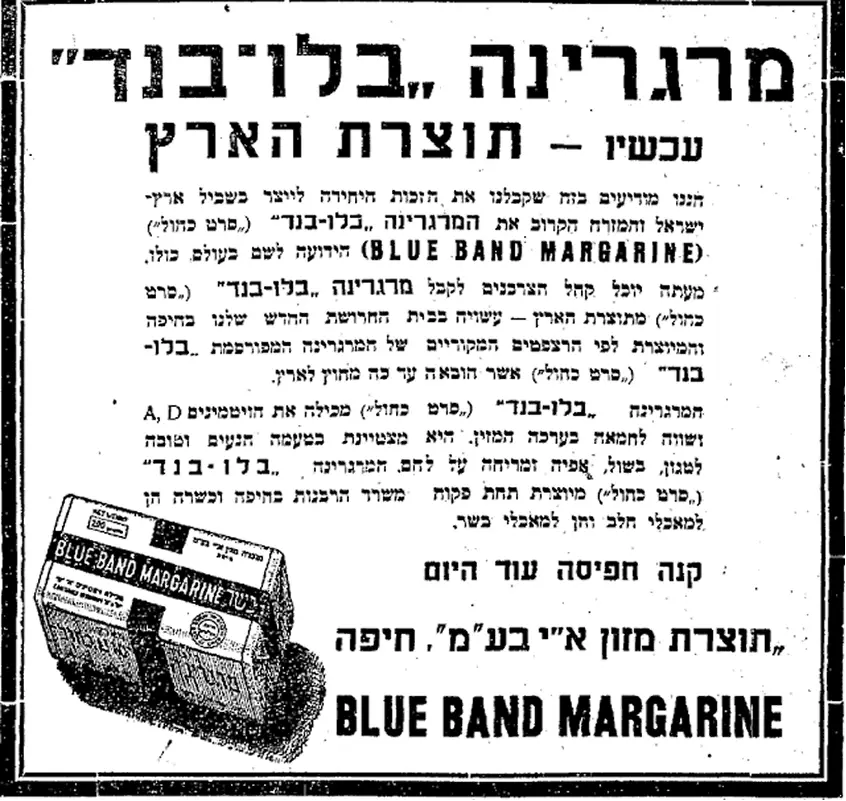
Newspaper advertisements
An advertisement in the newspaper “Davar,” January 20, 1939.
Dr. Aharon Arnold Hildesheimer, scion of a passionately Zionist rabbinical family, worked in Mannheim, Germany for the British Unilever company, which produced margarine. When the Nazis rose to power and Hildesheimer decided to move with his family to Palestine, he sought to establish a branch of Unilever there. But after the company turned him down, he decided to establish the factory on his own. In 1938, with the help of his connections with Moshe Wilboshvitz, the founder of the Shemen oil factory, Hildesheimer established a factory he called TAMI, an acronym in Hebrew for “Eretz Israel Food Production” in the courtyard of the Shemen oil factory in the Haifa Bay area. At the time, margarine was an unknown and expensive product on the local market when World War II broke out and rationing began in the country, ration coupons were issued for margarine.
In 1946, various spreads began to be produced, and thus the “Telma” department was established, which over the years branched out into production of a variety of food products. In 1961 the Blue Band brand of margarine became “Gold Band” – margarine with milk, packed in gold-colored aluminum. The name and packaging of the brand imparted a sense of luxury and quality to a basic product. It was the first time in the country’s history that a product was marketed by branding.
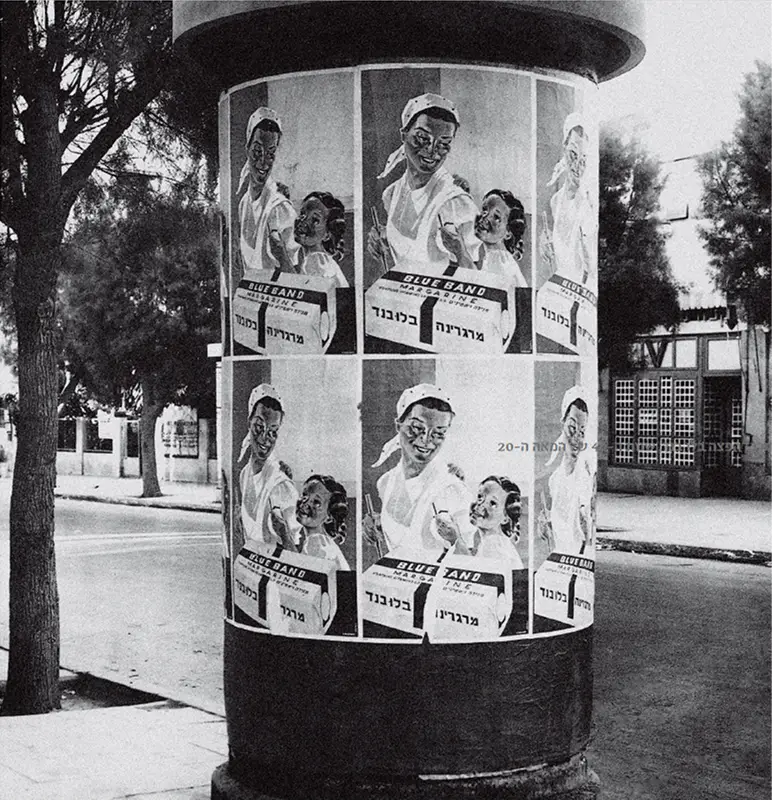
Street advertising
Street advertising from the 1940s .
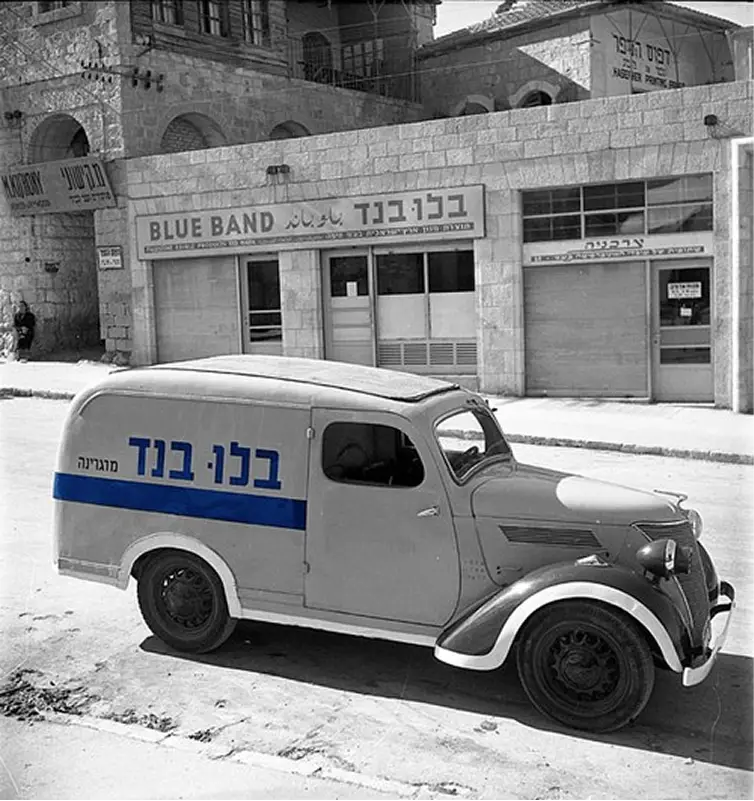
A Blue Band delivery vehicle in Jerusalem in the 1940s; photo: Photo Schwartz; courtesy of Nadav Mann, Bitmuna.
Telma
Haifa and the Krayot
Newspaper advertisements
An advertisement in the newspaper “Davar,” January 20, 1939.
Dr. Aharon Arnold Hildesheimer, scion of a passionately Zionist rabbinical family, worked in Mannheim, Germany for the British Unilever company, which produced margarine. When the Nazis rose to power and Hildesheimer decided to move with his family to Palestine, he sought to establish a branch of Unilever there. But after the company turned him down, he decided to establish the factory on his own. In 1938, with the help of his connections with Moshe Wilboshvitz, the founder of the Shemen oil factory, Hildesheimer established a factory he called TAMI, an acronym in Hebrew for “Eretz Israel Food Production” in the courtyard of the Shemen oil factory in the Haifa Bay area. At the time, margarine was an unknown and expensive product on the local market when World War II broke out and rationing began in the country, ration coupons were issued for margarine.
In 1946, various spreads began to be produced, and thus the “Telma” department was established, which over the years branched out into production of a variety of food products. In 1961 the Blue Band brand of margarine became “Gold Band” – margarine with milk, packed in gold-colored aluminum. The name and packaging of the brand imparted a sense of luxury and quality to a basic product. It was the first time in the country’s history that a product was marketed by branding.
Street advertising
Street advertising from the 1940s .
A Blue Band delivery vehicle in Jerusalem in the 1940s; photo: Photo Schwartz; courtesy of Nadav Mann, Bitmuna.