Ingredients for the dough 250 g flour 1 whole egg 1 Tbl olive oil A little tepid water Pinch of salt and sugar
Ingredients for filling 2 kg sour apples, peeled and cut into thin slices Drizzle lemon juice over the sliced apples 100 g melted butter 1 C sugar 1 Tbl ground cinnamon 4 Tbls breadcrumbs
Preparing the dough Mix all the ingredients well until the dough is as smooth as silk. Divide into four balls. Wrap each one in clingwrap and set aside for 20–25 minutes.
Combine the sugar with the cinnamon, add to the sliced apples and mix. Let stand for a bit to absorb the flavors. Roll out a dough ball into a very thin sheet so transparent you can see your work surface through it. Be careful not to tear the dough.
Spread melted butter on the rolled-out dough, leaving margins of about 3 cm. Place a single, even layer of breadcrumbs over the melted butter.
Place three large handfuls of the apples slices (without liquid) on the breadcrumbs.
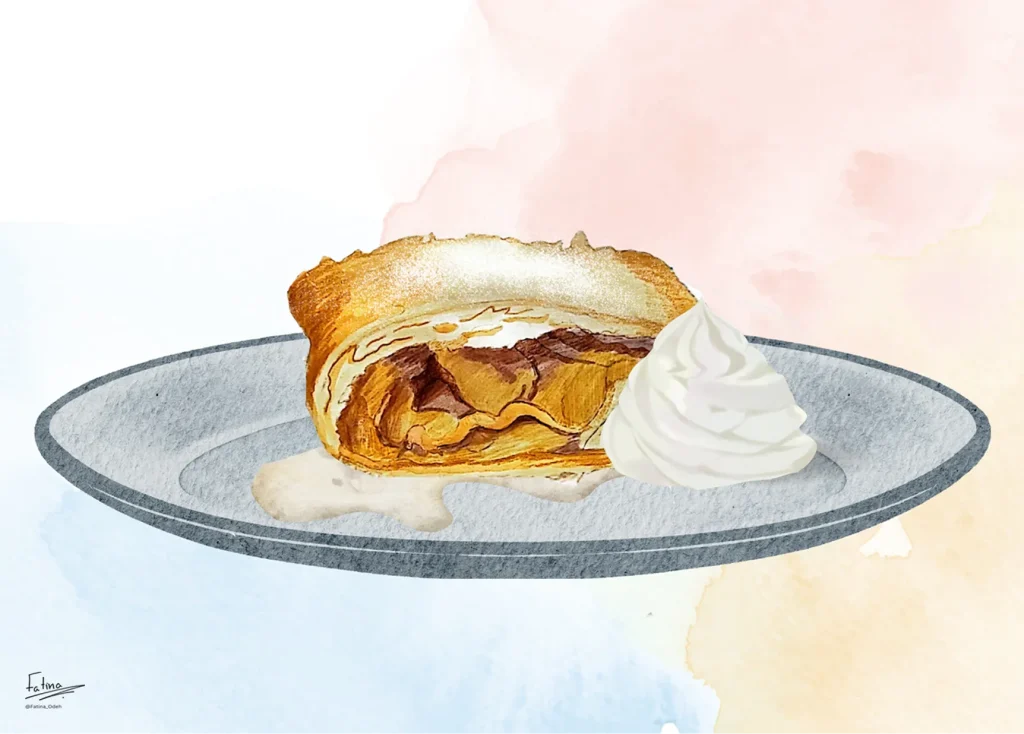
Seal the edges of the dough and flip the strudel, positioning it so the seam faces downward. Repeat with the other dough balls. Spread melted butter on all the strudels and place them in a medium-hot oven. Baste with more butter during the baking. Bake for 40 minutes. Sprinkle sugar on top before serving. Enjoy!
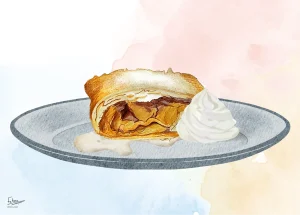
Apple Strudel
Apple Strudel
Ingredients
Ingredients for the dough 250 g flour 1 whole egg 1 Tbl olive oil A little tepid water Pinch of salt and sugar
Ingredients for filling 2 kg sour apples, peeled and cut into thin slices Drizzle lemon juice over the sliced apples 100 g melted butter 1 C sugar 1 Tbl ground cinnamon 4 Tbls breadcrumbs
Preparation
Preparing the dough Mix all the ingredients well until the dough is as smooth as silk. Divide into four balls. Wrap each one in clingwrap and set aside for 20–25 minutes.
Combine the sugar with the cinnamon, add to the sliced apples and mix. Let stand for a bit to absorb the flavors. Roll out a dough ball into a very thin sheet so transparent you can see your work surface through it. Be careful not to tear the dough.
Spread melted butter on the rolled-out dough, leaving margins of about 3 cm. Place a single, even layer of breadcrumbs over the melted butter.
Place three large handfuls of the apples slices (without liquid) on the breadcrumbs.
Seal the edges of the dough and flip the strudel, positioning it so the seam faces downward. Repeat with the other dough balls. Spread melted butter on all the strudels and place them in a medium-hot oven. Baste with more butter during the baking. Bake for 40 minutes. Sprinkle sugar on top before serving. Enjoy!
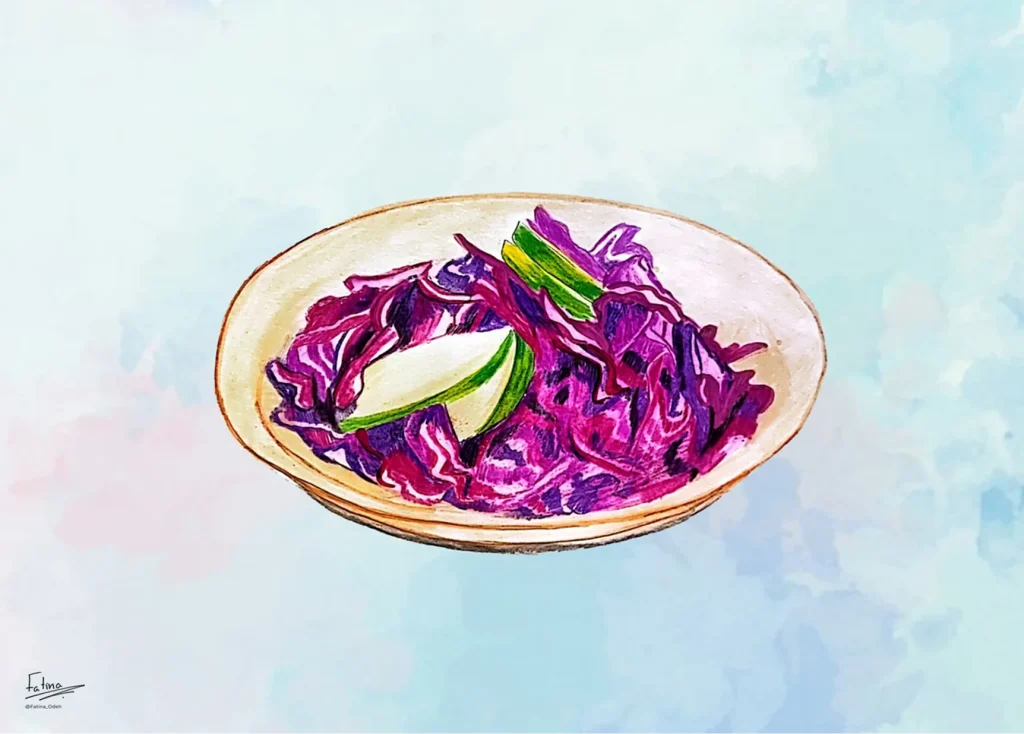
1 onion, sliced into thin strips ½ medium size red cabbage, sliced into thin strips 50 g speck (bacon fat) or butter. 1 potato, grated 1 green apple, peeled and grated 1 C white wine 1 level Tlb of brown sugar or honey Cinnamon, cloves, black pepper and salt to taste
Slightly brown the onion in the speck or butter. Add the red cabbage and wet ingredients and mix well over low heat. Add the rest of the ingredients and steam for 40 minutes, mixing occasionally and adding water if needed. Pairs well with mashed potatoes and meat. Enjoy!
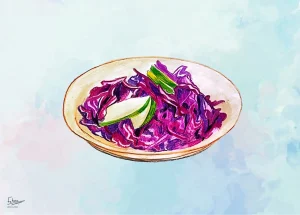
Cooked Red Cabbage
Cooked Red Cabbage
Ingredients
1 onion, sliced into thin strips ½ medium size red cabbage, sliced into thin strips 50 g speck (bacon fat) or butter. 1 potato, grated 1 green apple, peeled and grated 1 C white wine 1 level Tlb of brown sugar or honey Cinnamon, cloves, black pepper and salt to taste
Preparation
Slightly brown the onion in the speck or butter. Add the red cabbage and wet ingredients and mix well over low heat. Add the rest of the ingredients and steam for 40 minutes, mixing occasionally and adding water if needed. Pairs well with mashed potatoes and meat. Enjoy!
Chicken or two/ Chicken breasts for schnitzel Leftover old bread/Breadcrumbs Eggs (one egg per schnitzel) 1 Tbl mustard 1 Tbl milk Pinch of salt Oil (preferably sunflower) Cream cheese
Buy a chicken or two and separate the breasts from the chicken or buy chicken breasts for schnitzel at the butcher.
Take old bread, challah is best but even better – combine different kinds of bread: rolls, whole- wheat bread, etc. Slice the bread and dry for about two minutes in the microwave. You’ll need about two slices of bread per schnitzel. After drying, coarsely grate the bread. Or you could simply use ready-made breadcrumbs.
Crack eggs into a wide, deep bowl – one egg per schnitzel. Add 1 Tbl mustard, 1 Tbl milk, a pinch of salt, and mix using a fork until smooth. Scatter the breadcrumbs on a flat plate the size of the schnitzel.
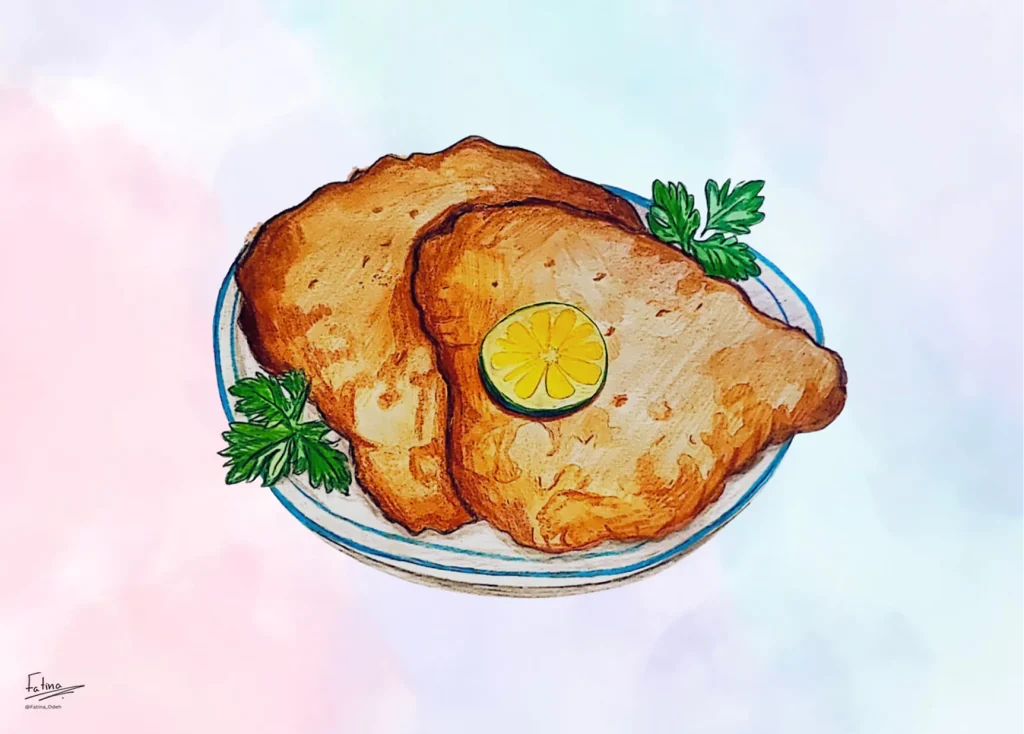
Make slits along the length of the breast and flatten with a meat mallet. Heat oil (preferably sunflower) in a deep, wide frying pan. Dip the tenderized schnitzel in the egg mixture and then in the breadcrumbs, then again in the egg mixture and the breadcrumbs. Dipping twice will ensure a thick, crispy coating. Carefully set the coated schnitzel in the boiling oil. Turn it over after two minutes and fry for another minute. When the schnitzel is ready, remove and place on absorbent paper towel on a plate. When you’re done, you’ll have delicious schnitzels and two bowls with remnants of the egg mixture and the breadcrumbs. Don’t discard! Mix the contents of the two bowls together, add a little cream cheese and fry into terrific cheese fritters. Enjoy!
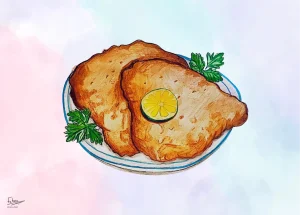
Schnitzel
Schnitzel
Ingredients
Chicken or two/ Chicken breasts for schnitzel Leftover old bread/Breadcrumbs Eggs (one egg per schnitzel) 1 Tbl mustard 1 Tbl milk Pinch of salt Oil (preferably sunflower) Cream cheese
Preparation
Buy a chicken or two and separate the breasts from the chicken or buy chicken breasts for schnitzel at the butcher.
Take old bread, challah is best but even better – combine different kinds of bread: rolls, whole- wheat bread, etc. Slice the bread and dry for about two minutes in the microwave. You’ll need about two slices of bread per schnitzel. After drying, coarsely grate the bread. Or you could simply use ready-made breadcrumbs.
Crack eggs into a wide, deep bowl – one egg per schnitzel. Add 1 Tbl mustard, 1 Tbl milk, a pinch of salt, and mix using a fork until smooth. Scatter the breadcrumbs on a flat plate the size of the schnitzel.
Make slits along the length of the breast and flatten with a meat mallet. Heat oil (preferably sunflower) in a deep, wide frying pan. Dip the tenderized schnitzel in the egg mixture and then in the breadcrumbs, then again in the egg mixture and the breadcrumbs. Dipping twice will ensure a thick, crispy coating. Carefully set the coated schnitzel in the boiling oil. Turn it over after two minutes and fry for another minute. When the schnitzel is ready, remove and place on absorbent paper towel on a plate. When you’re done, you’ll have delicious schnitzels and two bowls with remnants of the egg mixture and the breadcrumbs. Don’t discard! Mix the contents of the two bowls together, add a little cream cheese and fry into terrific cheese fritters. Enjoy!
70 g butter 3 egg yolks 3 egg whites 250 g farmer cheese (Canaan / Tuv Ta’am) 80 g flour 80 g breadcrumbs ½ tsp salt 125 ml sweet cream 1 heaping Tbsp sugar
For cooking 2 liters water 1 tsp salt
For the coating 100 g butter 4 Tbsp breadcrumbs Cherry jam
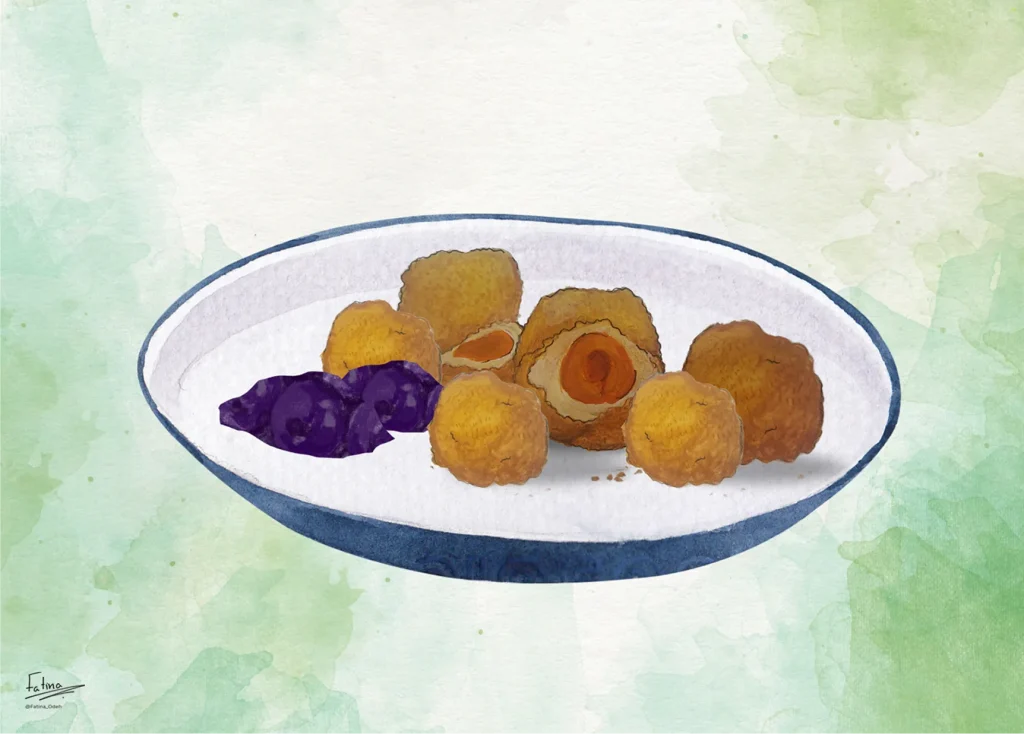
Separate the eggs and beat the whites until stiff. Transfer the beaten whites to a bowl. Place the yolks in the mixer bowl (no need to clean off any remaining whites). Mix the yolks and the butter until whipped and airy. Add the cheese, breadcrumbs, sweet cream, flour, and sugar to the yolks, and mix on low speed until the mixture is smooth and free of lumps. Fold the beaten egg whites into the mixture. Cover with cling wrap and refrigerate for at least half an hour. In a large pot, boil the water and salt. With wet hands, shape the mixture into ping-pong-sized spheres. Place the dumplings in the boiling water and cook over medium heat for 12–15 minutes, until they float. Melt butter in a frying pan, then add the breadcrumbs and stir for about 1 minute until they turn slightly golden. Turn off the heat. Roll the dumplings in the breadcrumbs until they are coated on all sides. Remove from the frying pan to a serving dish. Sprinkle granulated or powdered sugar on top. Serve immediately. Optionally, serve with cherry jam. Option: You can add a plum or an apricot when preparing the filling. Enjoy!
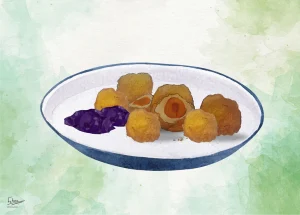
Cheese Dumplings
Cheese Dumplings
Ingredients
70 g butter 3 egg yolks 3 egg whites 250 g farmer cheese (Canaan / Tuv Ta’am) 80 g flour 80 g breadcrumbs ½ tsp salt 125 ml sweet cream 1 heaping Tbsp sugar
For cooking 2 liters water 1 tsp salt
For the coating 100 g butter 4 Tbsp breadcrumbs Cherry jam
Preparation
Separate the eggs and beat the whites until stiff. Transfer the beaten whites to a bowl. Place the yolks in the mixer bowl (no need to clean off any remaining whites). Mix the yolks and the butter until whipped and airy. Add the cheese, breadcrumbs, sweet cream, flour, and sugar to the yolks, and mix on low speed until the mixture is smooth and free of lumps. Fold the beaten egg whites into the mixture. Cover with cling wrap and refrigerate for at least half an hour. In a large pot, boil the water and salt. With wet hands, shape the mixture into ping-pong-sized spheres. Place the dumplings in the boiling water and cook over medium heat for 12–15 minutes, until they float. Melt butter in a frying pan, then add the breadcrumbs and stir for about 1 minute until they turn slightly golden. Turn off the heat. Roll the dumplings in the breadcrumbs until they are coated on all sides. Remove from the frying pan to a serving dish. Sprinkle granulated or powdered sugar on top. Serve immediately. Optionally, serve with cherry jam. Option: You can add a plum or an apricot when preparing the filling. Enjoy!
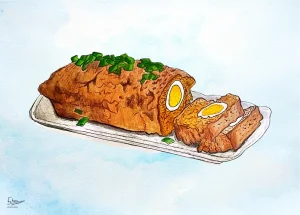
500 g good quality ground meat 1 large onion diced small 2 slices of bread, soaked with excess water pressed out ½ C chopped parsley 2 eggs 4 hardboiled eggs 3 Tbls breadcrumbs 1 tsp sweet paprika 2 crushed garlic cloves 1 tsp salt Black pepper to taste
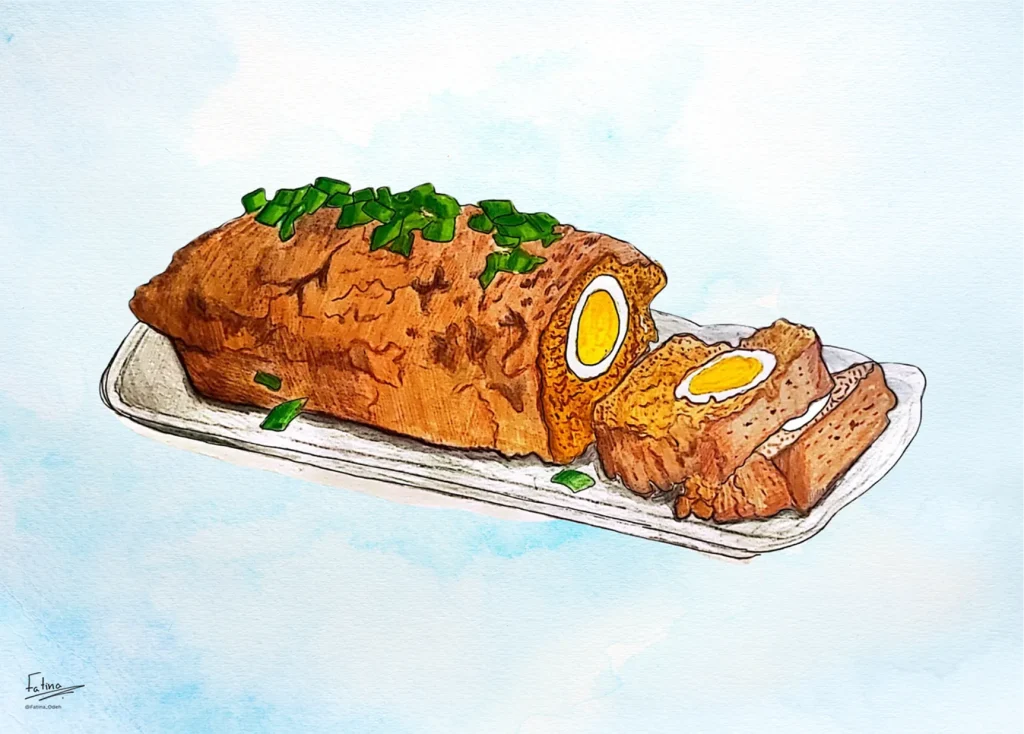
Mix all the ingredients thoroughly, excluding the hardboiled eggs, until the mixture is smooth. Pad the lower part of an oiled loaf pan with part of the mixture, to a height of about 1.5 cm. Place the hardboiled eggs on top, fill the spaces and cover all sides with the rest of the mixture. Spread the top with olive oil. Place in an oven preheated to 170o Celsius for 40 minutes. Let the meatloaf cool before slicing. Enjoy!
German Meatloaf
German Meatloaf
Ingredients
500 g good quality ground meat 1 large onion diced small 2 slices of bread, soaked with excess water pressed out ½ C chopped parsley 2 eggs 4 hardboiled eggs 3 Tbls breadcrumbs 1 tsp sweet paprika 2 crushed garlic cloves 1 tsp salt Black pepper to taste
Preparation
Mix all the ingredients thoroughly, excluding the hardboiled eggs, until the mixture is smooth. Pad the lower part of an oiled loaf pan with part of the mixture, to a height of about 1.5 cm. Place the hardboiled eggs on top, fill the spaces and cover all sides with the rest of the mixture. Spread the top with olive oil. Place in an oven preheated to 170o Celsius for 40 minutes. Let the meatloaf cool before slicing. Enjoy!
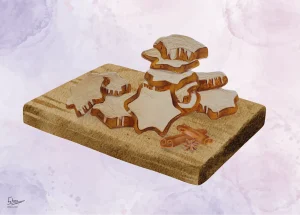
This recipe produces extraordinary cookies – very chewy and special – from almond dough and infused with the aromatic flavors of cinnamon and almond. But let’s admit it – that line and a half are not exactly enough information on how to make these cookies! Another good example that amazes me – how did they manage to prepare these delights based on a mere line and a half? They don’t even provide a quantity for the ground almonds! And what is a lot? Or a pfund? So I checked it all out. A lot is an ancient measurement that was common in Europe from the Middle Ages until the twentieth century and has disappeared. It’s about 1/30 or 1/32 of a pound. So a lot of sugar is about 1 tablespoon, about 16 grams. One-eighth of a pfund is in fact a fraction of a pound, a unit of measure still used in North America. Europe, however, since the early the twentieth century, has used units of kilograms and grams. This is a very well-known recipe that I remember from my own childhood. It produces a very rich cookie that is a winter staple in German pastry shops. Bertha Gumprich included it in her book in the chapter on Passover, because it contains no flour, making it particularly suitable for the holiday. Thus it became the German-Jewish Passover cookie. Here’s my version, adapted for contemporary baking, and of course, with all the details. Parveh, easy to prepare; 20 minutes prep time, 15 minutes baking.
(This recipe appears in issue 302 of “Yakinton”, published by the Association of Israelis of Central European Origin; Chef Tom Ferenc, promotor of the TV show Constructa).
300 gr ground almonds (with shell) 1 tsp cinnamon 2 egg whites Pinch of salt 200 g powdered sugar Powdered or finely ground sugar to sprinkle on your workspace.
Heat the oven to 160o Celsius. Line an oven pan with baking paper. In a bowl, mix the ground almonds and cinnamon. Place the egg whites in the mixer bowl and begin to beat, adding the salt and gradually adding the powdered sugar until the egg whites are very stiff. Remove about 1/3 cup of the egg-white mixture (you’ll use this meringue to coat the cookies).
Add the almond mixture and combine gently until the dough is even in texture – it will be sticky.
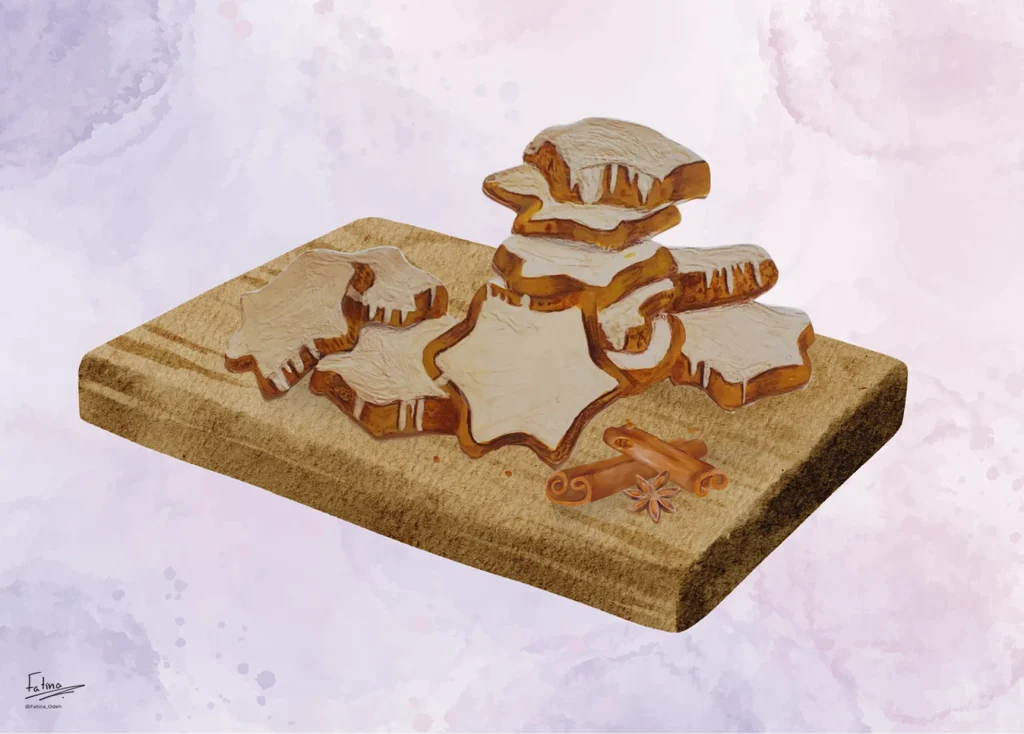
Place a sheet of baking paper on your workspace and sprinkle the powdered or finely ground sugar generously onto the paper. Place the dough, slightly flattened, on the paper and generously sprinkle it with more powdered or finely ground sugar. Place another sheet of baking paper on top of the dough and roll it out to a thickness of about half a centimeter. Using a star-shaped cookie cutter, form as many cookies as possible, and transfer them carefully to the baking paper on the oven pan.
Thinly spread the 1/3 cup meringue you set aside on the cookies. If it doesn’t spread easily, add a few drops of water.
You can set half a blanched almond on each cookie if you want. Bake for about 10–15 minutes until the cookies set and turn lightly golden (the meringue will remain white). They are at their best the day after baking and will keep for two weeks in a sealed box, making them ideal for preparation ahead of time. Serve with powdered sugar on top. Enjoy!
Cinnamon Stars for Passover
Cinnamon Stars for Passover
About the recipe
This recipe produces extraordinary cookies – very chewy and special – from almond dough and infused with the aromatic flavors of cinnamon and almond. But let’s admit it – that line and a half are not exactly enough information on how to make these cookies! Another good example that amazes me – how did they manage to prepare these delights based on a mere line and a half? They don’t even provide a quantity for the ground almonds! And what is a lot? Or a pfund? So I checked it all out. A lot is an ancient measurement that was common in Europe from the Middle Ages until the twentieth century and has disappeared. It’s about 1/30 or 1/32 of a pound. So a lot of sugar is about 1 tablespoon, about 16 grams. One-eighth of a pfund is in fact a fraction of a pound, a unit of measure still used in North America. Europe, however, since the early the twentieth century, has used units of kilograms and grams. This is a very well-known recipe that I remember from my own childhood. It produces a very rich cookie that is a winter staple in German pastry shops. Bertha Gumprich included it in her book in the chapter on Passover, because it contains no flour, making it particularly suitable for the holiday. Thus it became the German-Jewish Passover cookie. Here’s my version, adapted for contemporary baking, and of course, with all the details. Parveh, easy to prepare; 20 minutes prep time, 15 minutes baking.
(This recipe appears in issue 302 of “Yakinton”, published by the Association of Israelis of Central European Origin; Chef Tom Ferenc, promotor of the TV show Constructa).
Ingredients
300 gr ground almonds (with shell) 1 tsp cinnamon 2 egg whites Pinch of salt 200 g powdered sugar Powdered or finely ground sugar to sprinkle on your workspace.
Preparation
Heat the oven to 160o Celsius. Line an oven pan with baking paper. In a bowl, mix the ground almonds and cinnamon. Place the egg whites in the mixer bowl and begin to beat, adding the salt and gradually adding the powdered sugar until the egg whites are very stiff. Remove about 1/3 cup of the egg-white mixture (you’ll use this meringue to coat the cookies). Add the almond mixture and combine gently until the dough is even in texture – it will be sticky. Place a sheet of baking paper on your workspace and sprinkle the powdered or finely ground sugar generously onto the paper. Place the dough, slightly flattened, on the paper and generously sprinkle it with more powdered or finely ground sugar. Place another sheet of baking paper on top of the dough and roll it out to a thickness of about half a centimeter. Using a star-shaped cookie cutter, form as many cookies as possible, and transfer them carefully to the baking paper on the oven pan. Thinly spread the 1/3 cup meringue you set aside on the cookies. If it doesn’t spread easily, add a few drops of water. You can set half a blanched almond on each cookie if you want. Bake for about 10–15 minutes until the cookies set and turn lightly golden (the meringue will remain white). They are at their best the day after baking and will keep for two weeks in a sealed box, making them ideal for preparation ahead of time. Serve with powdered sugar on top. Enjoy!